molly springfield
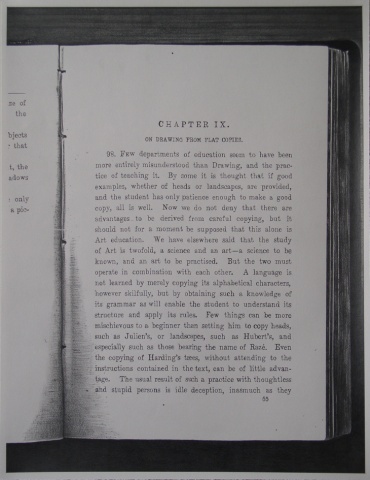
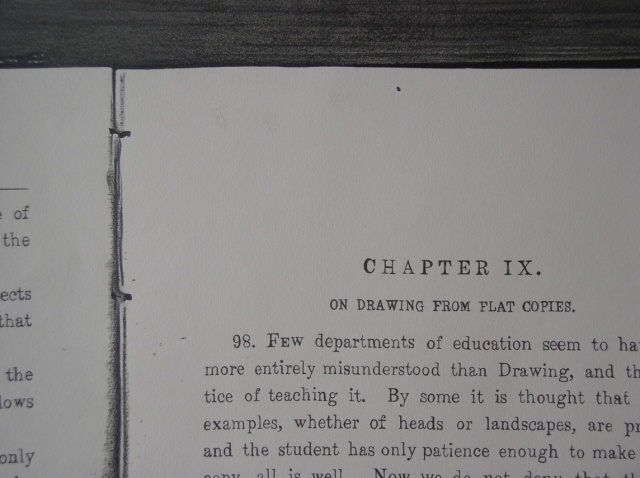
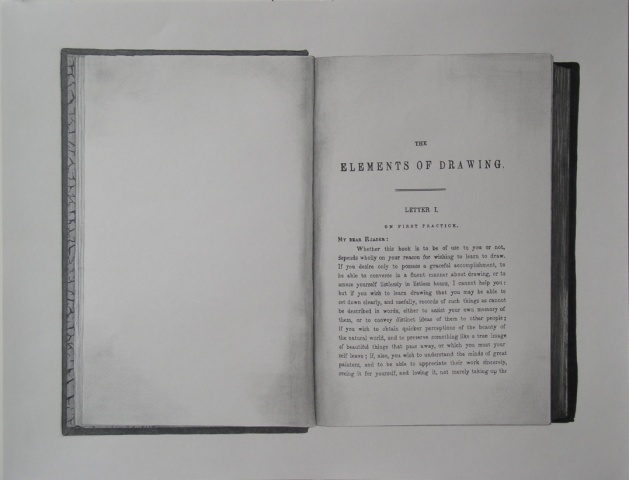
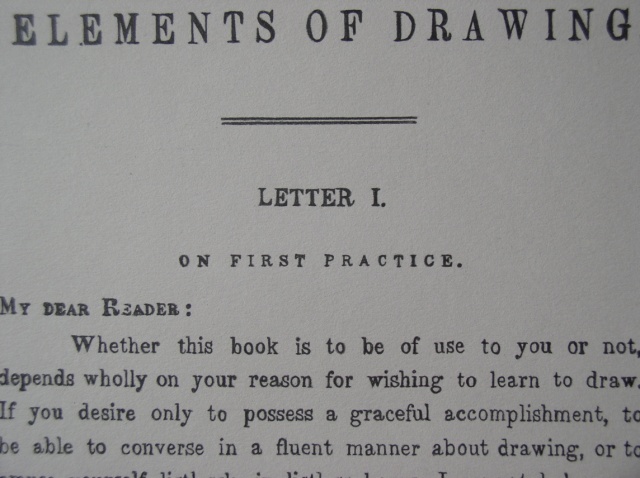
Chapter IX Chapter IX (detail) On First Practice On First Practice (detail)
Drawings About Drawing
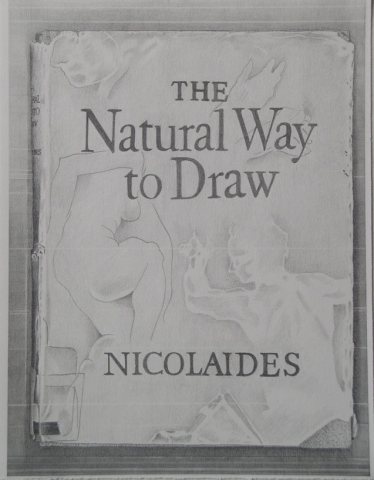
These two drawings are the beginnings of an investigation in to the historical trajectory of drawing instruction, from Renaissance anatomical manuals, to Victorian-era handbooks (like the John Ruskin and William Walker texts that you see reproduced in the drawings), to the more popular psychological approaches of the twentieth-century (such as Betty Edwards’s Drawing on the Right Side of the Brain).

One of the drawings depicts a passage in The Elements of Drawing (1857), in which Ruskin outlined his philosophy of drawing. For Ruskin and his contemporaries, “accomplishment” in drawing was seen as a way for students to learn to “see,” to gain an appreciation for the natural world’s beauty. Ruskin believed that “the teaching of art … is the teaching of all things,” so as his students learned drawing they would also gain insight into the humanities and natural sciences.

The other drawing comes from a book by William Walker, a lesser-known contemporary of Ruskin’s, and a lecturer of freehand drawing at Owens College (now Manchester University). He published his own Handbook of Drawing in 1878. Both Walker and Ruskin studied drawing under the same teacher, J.D. Harding. Like Ruskin, Walker believed that his drawing students “should naturally expect to go through some labour, perhaps drudgery, of preparation, equivalent to learning French verbs, or Greek hexameters.” The reward for such diligence would be, in Ruskin’s words, “sufficient power of drawing faithfully whatever you want to draw,” and the ability “to set down clearly, and usefully, records of such things as cannot be described in words.”

Although I’m only at the beginning of my investigations, I already find that I have an uneasy and uncertain relationship to these texts. On the one hand, they seem silly and anachronistic in their insistence of drawing as a kind of medicine, their rigid prescription of faithful representation as an end in itself rather than as a means to generating original content. On the other hand, their old-fashioned, modernist emphasis on the importance of labor, practice, and craft is oddly refreshing in an era of quick and easy solutions.
BACK TO PROJECTS